[Windows Phone] Windows Phone Power Tools – the best way to work with Isolated Storage
Isolated Storage is a storage area on Windows Phone which, exactly as its name says, is Isolated. Isolated means other apps cannot access it, and you cannot access other apps either (unless you have root, which is only for the Lumia 710 cooked rom)
So while developing an app, how do you access this storage in a visual, lively and easy way?
There is a way, and in my opinion it is the best one: extremely visual, lively and easy to work with. You don’t have to type a single command to run it, unlike the Isolated Storage Explorer Tool
1. Installation
Download and install it from: Windows Phone Power Tools on CodePlex
2. Usage
Open any Windows Phone project, Run with Emulator (or Device)

You have to wait until the app actually starts running on the Emulator or device, then go back to Power Tools and hit Connect — remember to pick the same device you are building the project against

And that’s it
2.1. Install | Update
This part lets you install a new app or update an app that already exists on the device. All you need is a running Emulator (or a connected device) and the app’s XAP file. For Windows Phone 7 you also need Zune. You can only install apps that have not been signed by the store (an already signed app cannot be installed). And you can only update apps that are being developed
2.2. Dev Apps
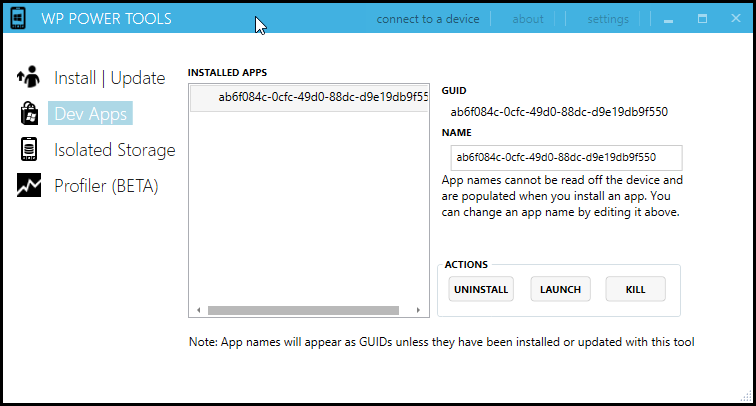
This section lets you tweak a number of things about the app currently being developed on the device.
2.3. Guild
The Guild is your app’s identifier. Every app has its own Guild number. And this number gets overwritten once the app is uploaded and verified on the store
2.4. Name
The name of your app. You can edit it to make things easier to read when you use Power Tools to develop several apps at the same time


Press Enter after renaming, and your app now has a new name.
You have to connect to the device once more for this change to show up in Isolated Storage. Click the Connect to a device button at the very top of Power Tools and connect again
2.5. Isolated Storage

The main component of Power Tools
If you still see your app as a Guild number string after renaming it in the Dev Apps section, click
connect to a deviceon the title bar and reconnect to the emulator or device — you will see the app name change as expected
This is exactly the Isolated Storage of the app you are running on the machine. This Isolated Storage reflects precisely everything you have in the real storage, laid out as a folder structure. Click any file or folder and its information shows up

2.6. The Get button
The get button lets you take the file you have selected and save it on your computer. You can also double click a file to open it directly, but that is only a copy of the file you selected in Isolated Storage — any edit you make to that file will not be saved back into Isolated Storage
2.7. The Put File button
This button lets you “put” a file into Isolated Storage. More precisely, it copies a file from your computer into Isolated Storage. The Overwrite Existing option overwrites a file with the same name
2.8. The Put Directory button
Same as the put file button, but for a whole folder
2.9. The Delete button
Deletes a file from Isolated Storage. You cannot restore it. Think twice before deleting. Keep a copy of those files on your computer
2.10. Profile (Beta)
According to the developer, this tool helps you profile your app. In my testing, it doesn’t work all that well.
- Asks for administrator rights –> granted administrator rights
- Asks to restart Power Tools –> done
During my testing, Power Tools crashed and could not be restarted. After reinstalling, there was no device in the list to connect to.
2.11. The workaround
Uninstall > Reinstall > Shut down the Emulator / Disconnect the device > Start the Emulator again / Reconnect
3. Conclusion
Power Tools is, in my opinion, the best tool for working with Isolated Storage, but its Profile tool has some annoying bugs. Apart from that bug, everything is great